The Mahons of Offaly
The Cooldorragh Glebe and Killurin Mahon Clans
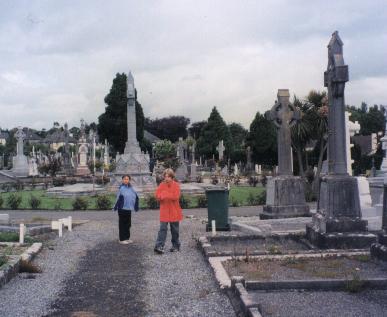
In 2003 I visited Ireland and carried with me 3 DNA kits by Family Tree DNA. My purpose was to test the oral histories of the Mahon Clan against the what data would emerge from DNA. This was a personal journey in that the Mahons of Cooldorragh Glebe in Ballyboy are my ancestors and cousins. DNA testing would therefore reveal my own history.
The Killurin Mahons have an oral history of having descended from the Monaghan McMahon of Oriel. And the Cooldorragh Glebe Mahons had an oral history that suggested either the Clare McMahons or Oriel McMahon had been present in Offaly, which is true, and launched their clan. Neither oral history is accurate. It appears to me that the Mahon families of Offaly (and Carlow) represent a very small clan that arose separately and was perhaps largely eliminated by the various tribal conflicts and subsequent numerous Norman invasions.
This presentation does not apply to all persons named Mahon. It appears that the name sprung up in numerous places in the Midlands and Southern Ireland. In the territories I have explored as possible places of origin there appear to be at least three different Mahon clans who are not genetically related. Or they are not related in a way that matters. A significant portion of all the Irish stem from an influx of people about 4000 years ago. This immigration event is represented by Rathlin Man, an individual unearthed on Rathlin Island. Rathlin Man is representative of that immigration and most of us are related to that degree. I am instead focused on identifying our heritage in the realm of 300 CE to 1800 CE. After this point there are records we can trace but during that time span the only way to track our history is through the use of DNA testing.
There are at least three distinct Mahon families in County Offaly. One family, represented by Mahon kit 15092, is centered at Killurin in Geashill. A second Mahon family is represented by historical farmers in Birr and attorneys in Tullamore today who have not tested their DNA, so this paper cannot be said to apply to them. The third is ours, and it’s centered at Cooldorragh Glebe in Ballyboy. DNA has shown that ours is closely related to a group of Mahons that resides near Borris in County Carlow. Because they exactly match the Mahon clan of Cooldorragh Glebe, they likely descend from a brother of John Mahon of Cooldorragh Glebe who died in 1840.
| Kit | Name | Ancestor | Haplotype |
|---|---|---|---|
| 15092 | Killurin Mahon | Mahon, d. 2003 | R-S5456 67 marker test |
| 14151 | McMahon (USA) | John Mahon, d. 1840 Cooldorragh Glebe | R-S5456 67 marker test |
| 14150 | Mahon | John Mahon, d. 1840 Cooldorragh Glebe | R-L21 25 marker test |
| MK94187 | McMahon (USA) | John Mahon, d. 1840 Cooldorragh Glebe | R-FTD95602 Big Y700 |
| 194111 | McMahon (USA) | Michael Mahon, b. 1800, County Carlow | R-DF21 67 marker test |
DNA TESTING
DNA testing reveals your history in two ways. First, by what are called the haplotypes or the genetic makeup of your DNA. These are called SNPs. SNP matches refer to identical points or segments of DNA where two or more people share the same single-nucleotide variation (a single-nucleotide polymorphism, or SNP, pronounced “snip”) at a specific location in the genome. In our case the assigned numbers to this genetic sequence are:
WHAT DO THE NUMBERS SAY?
FGC3213] (DF21>FGC3213>ZZ1-1>S5459>S5456E1> S5456E1> S5456>Z29558)>R-FTD95602
The key features in the above numbers are:
DF21 – a marker that represents the Bell Beaker and Celtic lineages of Ireland (source: FTDNA), having a common ancestor with Rathlin Man 4000 years ago.
S5456 – known both as the Aran Variety (DYS 390=23, DYS 385b =11) and the Galway Bay Cluster, thought to suggest that the marker ties its carriers to western Galway. Most common ancestor approximately 300 CE.
Z29558 – most recent common ancestor: 100 – 600 CE, represents at least two of the Delbhna tribes: Delbhna bEthra and Delbhna Cuile Fabhair. It may well represent additional Delbhna tribes which have not yet been adequately identified genetically, such as Delbhna Nuadat.
R-FTD95602 – this is an unmatched SNP that will only be further defined when other RELATED Mahons join the project using a Big Y700 test. Doing so will allow us to further explore and fine tune our origins.
Conclusion: These markers dispel the notion that the Mahon clans of Offaly are descended from either the Monaghan or Clare McMahon lineages. The Mahon DNA does not match either clan. If you would like to see the specific SNPs of these clans you may visit the McMahon Project on FTDNA. FamilyTreeDNA – McMahon Project DNA Results
THE DELBHNA TRIBAL CONFEDERATION
The Delbhna were never a singular dominant superpower in the Irish midlands, as they spent most of the historical era as a subject people under more powerful dynasties. However, their period of greatest independent influence and presence in the midlands occurred prior to the late 5th century, before they were subjugated by the expansion of the Uí Néill and Uí Maine
CONCLUSIONS
Both the Cooldorragh Glebe and Killurin Mahon families as well as the Carlow Mahon family descend from the Delbhna Tribal Confederation. The genetics suggests Delbhna bEthra or Delbhna Cuile Fabhair but in part because those two tribes have been linked to haplotype Z29558 by 21 different DNA testers (DF21 project).
There are too many Galway/Roscommon matches to be ignored. There are also no Offaly matches. Another possibility is Delbhna Nuadat. Delbhna Nuadat (Athlone in County Roscommon, situated between the Suck and Shannon Rivers and eastern County Galway) was defeated by the Ui Maine in the year 751 CE (Wikipedia). Afterwards the Delbhna mixed genetically with Ui Maine names which would include Egan, Cain, Keane, Lambe and others mentioned above.
There were far too few Cooldorragh Glebe Mahons in 1840 to suggest Ballyboy as their place of origin. All of them descend from John Mahon and Rose Molloy, circa 1845, grandfather John Mahon, Sr, d. 1840. It is much more likely that they relocated there from someplace else due to some Norman incursion. Having an exact genetic match in the Borris area of County Carlow confounds the picture.
The Killurin Mahons may have been present in Offaly as far back as the early 1600s as suggested by written correspondence (James Mahon to Hugh Mahon, Australia). Still, their matches suggest close ancient ties to the Cooldorragh Glebe and Carlow Mahons in a location other than Offaly prior to the 1600s.
WHATS NEXT
In order to draw further conclusions and hone in on the exact place of origin we need additional FTDNA Big Y 700 testers from the following families: Killurin Mahon, Carlow Mahon, the Birr/Tullamore Mahon family, the Mahon families living in Banagher and Lusmagh (near the border with Galway), Mahon families in Athlone and Westmeath, and eastern Galway, particularly Clonfert if the testing family dates to before the time of the Castlegar Mahons. Read the entire study here:
Join the project. Buy a test here: Trace Your Paternal Ancestry With Y-DNA – FamilyTreeDNA – be sure to join the Mahon, McMahon, and DF21 projects when you join. This will allow me to collaborate with those project administrators to evaluate your results as I will not be able to view your matches myself.