The Three Collas Recovered
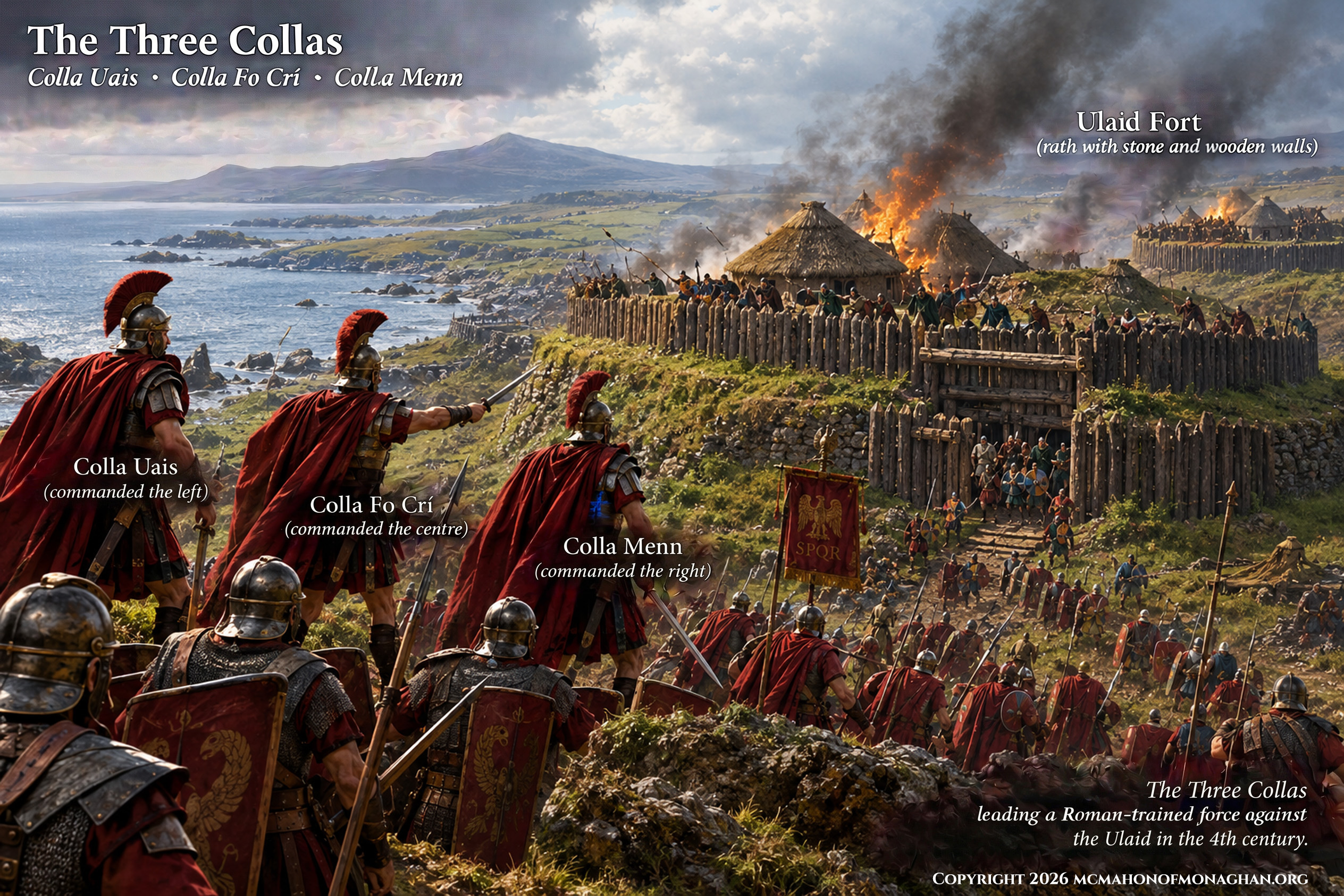
The ideas set forth here first appeared in two articles in The Clogher Record, both written by Donald M Schlegel: “The Origin of the Three Collas and the Fall of Emain” (Vol. XVI, No. 2, 1998, pp 159-181) and “Reweaving the Tapestry of Ancient Ulster” (Vol. XVII, No. 3, 2002, pp 689-749) Since their publication the advent of dna analysis has provided support for this scenario.
The “Three Collas” were named Carrell Colla Uais, Muredach Colla da Crioch, and Aedh Colla Menn and were said to be brothers. They came to Ireland from Roman Britain in the fourth century, no doubt with a cadre of followers and relatives. Based on their family’s later collective name, the Airgialla, it seems that their family had originated among the British Trinovantes in the vicinity of Colchester in southeastern Britain. Roman citizenship had been conferred on all free subjects of the empire, including free Britons, in 214 A.D. The Collas used the typical Roman naming system, not used by others in Ireland, consisting of personal prenomen, family nomen, and descriptive cognomen. Two of their descriptive names point to this foreign, military origin, for da Crioch earlier was Focrach, meaning “mercenary,” and Menn means stutterer, indicating an immigrant. The three had experience in the military forces of the Empire, perhaps as centurions under a kinsman who was a vicarius of their tribune and in legend became known as their grandfather, Ugari.
They may have migrated about 367, when there were mass desertions from the Roman army in Britain. This was in the time of the generation preceding the Irish “high-king” Néill Noighiallach, and they and their families became military leaders for his descendants, the Uí Néill. They were sent against the Ulaid, the ruling people of Ulster, with whom the “high kings” had been warring without progress for generations. They achieved a signal victory at Carn Achadh Leth Derg, perhaps at Carn Roe in Currin Parish, County Monaghan, sometime around the year 390. This resulted in their taking sword-lands in Fermanagh, Tyrone, and Monaghan and the overlordship of the peoples already in that area, including those later identified as the Mugdorna. The lordship of this first conquest was in the family of Colla da Crioch, while the family of Colla Menn became overlords of the Mugdorna.
A second campaign was mounted by the son and grandsons of Colla Uais and the sons of Néill Noighiallach about the year 425. This took north-central and northwest Ulster from the Ulaid. The sons of Néill took as their own the lands west of the Foyle. Families descending from Colla Uais took the lordship of lands east of the Foyle, serving as a buffer between the Uí Néill and the Ulaid.
A third major campaign was waged about 470. The Airghialla, led by Colla da Crioch’s grandson Felim, under the Uí Néill king of Tara, entered Ulaid territory and won the battle of Craeve Derg at the ancient pagan complex at Emain Mhacha in present County Armagh, symbolic center of the Ulaid. This drove the Ulaid east across the Newry River, taking Emain Macha from them and destroying whatever had remained there of their pagan religion. St. Patrick, who had been given a site at Armagh by the Ulaidh about 455, now moved east into Down with them, leaving Armagh in the hands of Sechnall, Bishop of Meath, for several years, as appears from the list of the Archbishops of Armagh. These “eastern” lands were taken by descendants of Colla da Crioch.
As late as the early seventh century the Airgialla were still tributary to whoever was the king of the Uí Néill. It was not until about the year 650 that the Airgialla began to fall under the sole dominion of the Northern Uí Néill at Ailech and Tir Eógain.
Some centuries after the lives of the Collas, the Irish historians undertook to unite all of the peoples of Ireland by creating a common genealogy and history for them. As part of this process, Colla Uais was made to have been a High King and a relative of the Uí Néill. To place him “correctly” in the chronology that they created, they had to place him two generations prior to his actual era. The earliest firm dates among the descendants of the Collas belonged to sixth century descendants of Colla da Crioch, so the historians and genealogists inserted two generations into this family to push the three brothers back in time. In the genealogies, Fiachra Cassan remains son of Colla da Crioch, as ancestor of several families that did not have detailed genealogies. But he also appears as Fiac, ancestor of the well-known and documented ancestors of the Clan Kelly, Maguire, McMahon, and others. This Fiac was said to have been son of Deach Dorn son of Rochadh son of Colla da Crioch. This shift in generations is made quite obvious by the list of Saints of Sliocht Colla da Crioch written about 1600 by Míchél O Cleirigh, with later additions by John Colgan. These saints and other holy ones appear in the fifth generation after Fiachra Cassan but in the seventh and eighth generations after his “brother” Rochad in the revised genealogy of that branch of the family.
by Donald M Schlegel – September 2026